
If you are planning to attend the Canton Fair 2026, the most important work starts before you enter the exhibition hall. A fair visit can produce hundreds of contacts and product photos, but without a clear sourcing brief, it is difficult to compare suppliers, request useful quotations, or decide which samples deserve a second review.
The 140th Canton Fair is scheduled to take place in Guangzhou from October 15 to November 4, 2026, in three phases. The official schedule lists Phase 1 from October 15 to 19, Phase 2 from October 23 to 27, and Phase 3 from October 31 to November 4. Buyers should always confirm the latest information on the official Canton Fair website before making travel arrangements.
This checklist explains what to prepare before the fair, what to record at each booth, and what to do after you return.
1. Start with a sourcing brief, not a product wish list
Before contacting exhibitors, write a one-page sourcing brief for each product category. The brief should answer:
- What product are you looking for?
- Which market will you sell into?
- What target price range is commercially realistic?
- What order quantity or trial quantity do you expect?
- Do you need standard products, private label, OEM, or custom development?
- What packaging, labelling, testing, or documentation is required?
- When do you need samples and when must production be completed?
The purpose is not to reveal every detail of your business. The purpose is to give suppliers enough information to respond to the same commercial question. If every supplier receives a different description, the quotations will not be comparable.
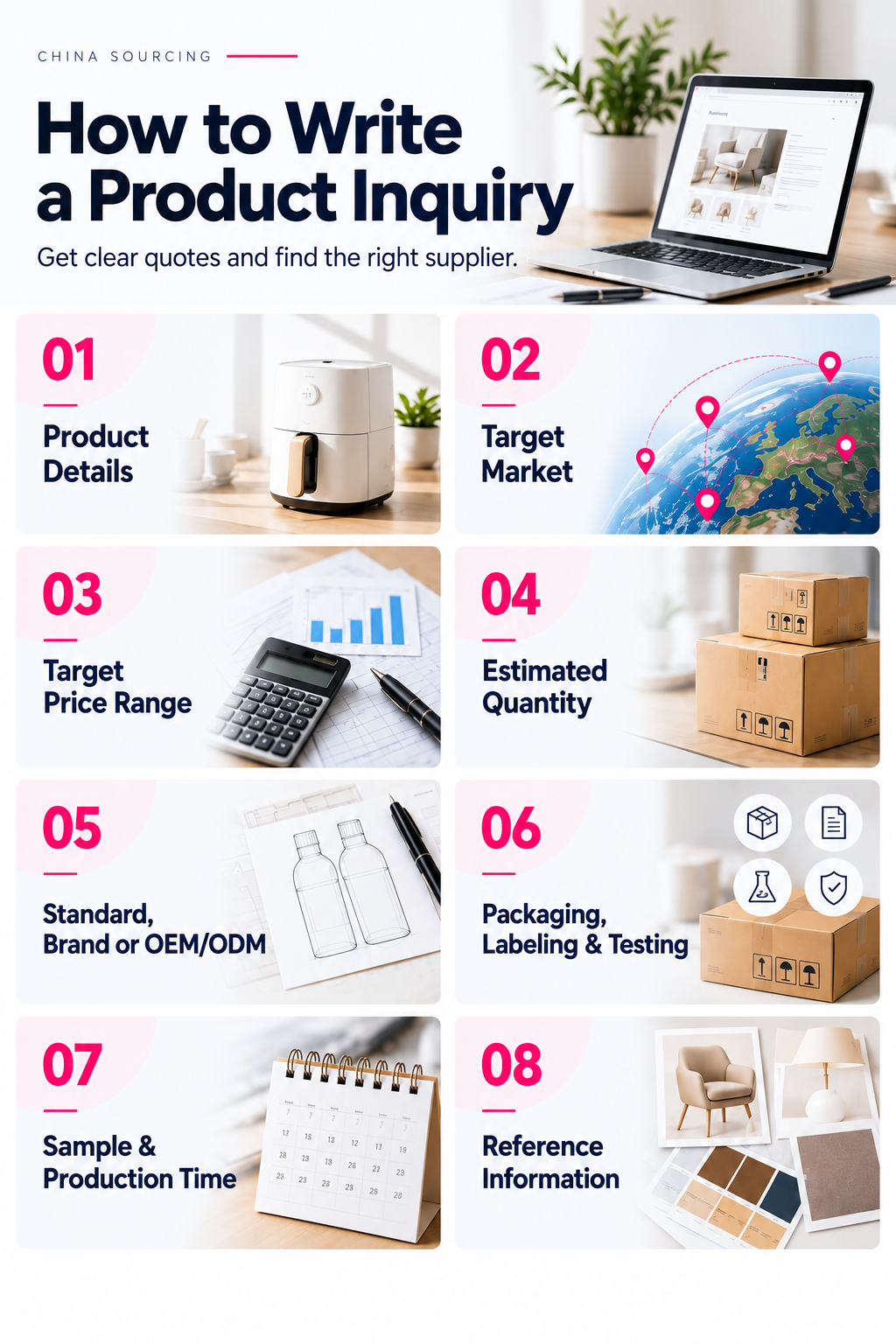
For a multi-category retail project, create a separate product sheet for each SKU or product family. Include reference images, dimensions, materials, colours, target packaging, estimated order volume and any non-negotiable requirements.
2. Match your product category to the correct phase
The Canton Fair is organised by product categories across different phases. Do not plan your trip only around the overall fair name. Start by matching your purchasing list to the relevant phase and then build a route through the halls.
For example, electronics, appliances, lighting, machinery and related industrial products are generally associated with the manufacturing-focused phase. Home goods, kitchenware, gifts, decorations and many consumer products are associated with the quality home-life phase. Clothing, textiles, office supplies, toys and other everyday products are associated with the later phase. The exact categories and dates can change, so verify them through the official fair information before booking meetings.
If your assortment covers several phases, decide whether the additional travel time is justified by the value of the supplier search. Some buyers are better served by focusing on one category first and arranging factory or market visits afterwards.
3. Build a shortlist before you travel
Walking through every hall without a shortlist is tiring and usually produces poor follow-up. Prepare three groups of exhibitors:
Priority meetings
These suppliers match your product, target market and order requirements. Contact them before the fair and request a meeting. Ask them to prepare relevant samples, product specifications and an initial quotation framework.
Comparison booths
These suppliers may offer similar products and can help you benchmark materials, packaging, MOQ, lead time and price structure. You may not need a formal meeting, but you should record enough information for comparison.
Discovery booths
These are suppliers or product ideas you did not expect to find. Keep a small amount of time for discovery, but do not allow unplanned browsing to replace the meetings that matter most.
Your shortlist should include the company name, booth number, product category, contact person, meeting time and the questions you want answered. Leave space between meetings. A realistic schedule should allow time for walking between halls, revisiting promising booths and handling conversations that run longer than expected.
4. Ask questions that reveal supplier suitability
The first question should not be “What is your lowest price?” A low price without the right specification is not a useful quotation. Ask questions that help you understand whether the supplier fits the project:
- Are you the manufacturer, a trading company, or a combination of both?
- Which production processes do you control directly?
- Which products are your core export products?
- What is the MOQ for the standard product and for custom packaging?
- What is the sample lead time and can the sample be modified?
- Which markets do you regularly export to?
- What quality checks are completed before shipment?
- Can you provide specifications, test reports, packaging details and product photos?
- How do you handle changes, defects, delays and repeat orders?
- What information do you need from us to prepare a comparable quotation?
For electronics and products with technical or compliance requirements, also ask about the exact model, components, power specifications, firmware, warranty process and documents applicable to that model. Do not treat a general company certificate as proof that every product or model meets every market requirement.
5. Record each supplier in the same format
Take notes immediately after each conversation. A practical supplier comparison sheet should include product code and specifications, MOQ and payment terms, sample cost, lead time, customisation ability, packaging and carton details, quality checks, testing documents, logistics assumptions, contact person and next action.
Photograph the product, product code and business card together where possible. A product photo without a code or specification is difficult to use once you return home.
6. Do not choose a supplier from the booth alone
A large booth, a polished catalogue and fluent sales communication can be useful signals, but they are not a complete supplier evaluation. After the fair, request samples and compare them against the written specification. Check dimensions, materials, finishing, colour, function, packaging and labelling.
If the project is important, arrange additional supplier verification before placing a production order. Depending on the product and risk, this may include a company check, factory visit, sample approval, production inspection, pre-shipment inspection or document review.
For a multi-supplier order, use one specification format across all suppliers. Otherwise, one supplier may quote per piece, another per set, and another per carton. The numbers may look different even when the underlying product quantity is similar.
7. Plan the post-fair follow-up before the fair begins
The value of a Canton Fair visit is often decided during the two weeks after the event. Before you travel, prepare a follow-up template that asks for:
- a quotation based on the same specification;
- sample and tooling costs, if applicable;
- packaging and carton details;
- production lead time and the earliest realistic ready date;
- testing or compliance documents relevant to the product;
- payment and shipping assumptions;
- the supplier’s proposed next step.
Rank suppliers into three groups after the fair: follow up immediately, keep for comparison, and do not pursue. Do not send the same generic message to every contact. Mention the product code, your meeting discussion and the information you still need.
If suppliers are located in different cities, the next stage may include market visits, factory visits, sample consolidation, quality control and shipment planning. These activities should be coordinated as one procurement project rather than handled as unrelated tasks.
How MU Group can support an international buyer
MU Group positions itself as an integrated supply chain and procurement services company, with purchasing management and design in Asia. For a buyer sourcing across multiple product categories, the practical value of a supply chain partner is not simply adding more supplier contacts. It is helping turn those contacts into a controlled process: product selection, supplier comparison, sample coordination, quality control, packaging, consolidation and international logistics follow-up.
The right question after the Canton Fair is not “How many business cards did we collect?” It is “Which suppliers can meet our specification, what evidence do we have, and what is the next verified step?” A clear preparation system makes that question easier to answer.
Final checklist
- matched your categories to the correct fair phase;
- prepared product briefs and reference images;
- booked priority supplier meetings;
- created one comparison sheet for every supplier;
- prepared technical and compliance questions;
- planned sample, factory visit and quality-control follow-up;
- confirmed the latest official fair information;
- set a post-fair quotation and supplier-ranking process.
Official source: China Import and Export Fair