
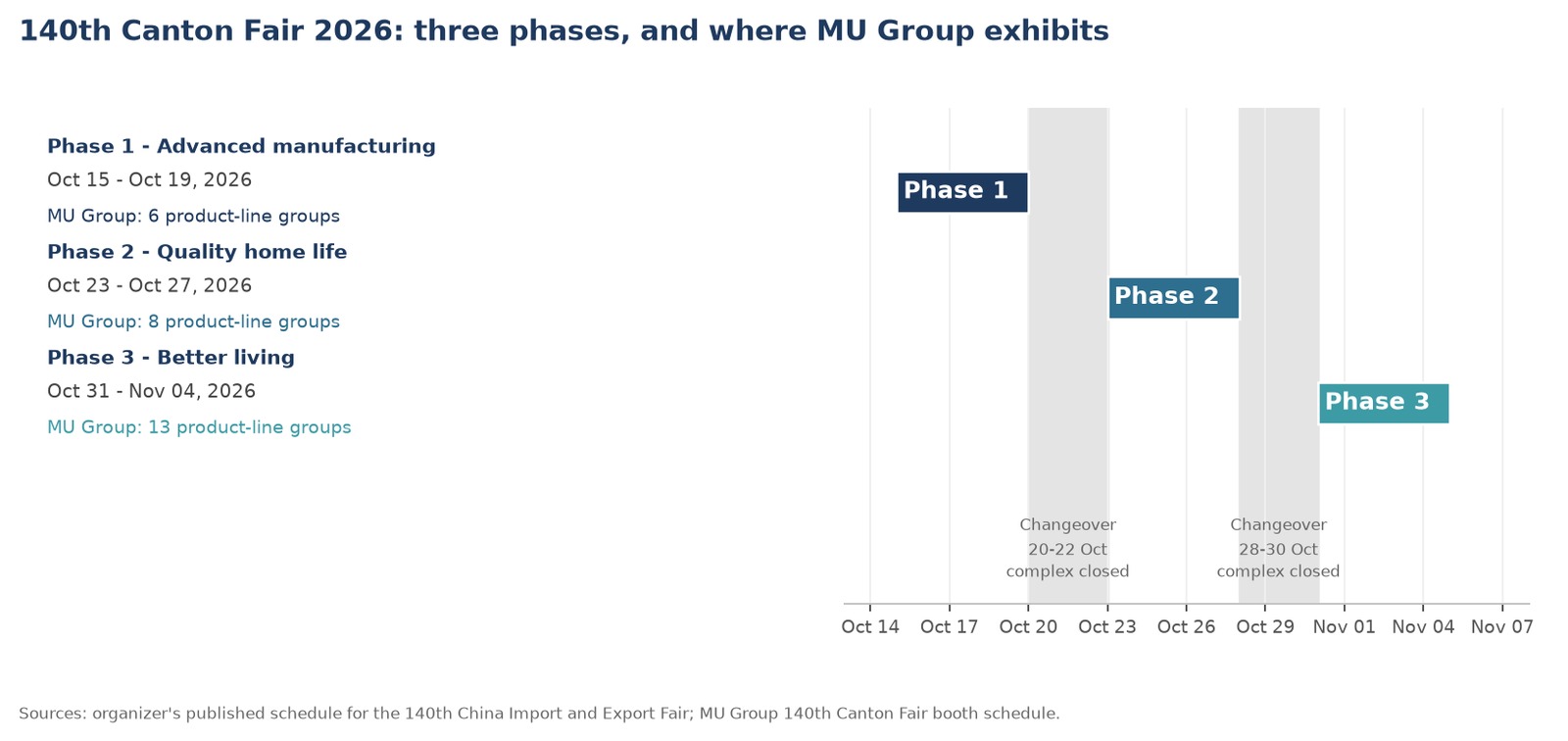
Canton Fair Phase 3 runs from 31 October to 4 November 2026 at the China Import and Export Fair Complex in Pazhou, Guangzhou. It is the Better Living phase, and it carries the wearable and the everyday: men’s and women’s wear, children’s wear, underwear, sportswear and casual wear, fur and down products, garment accessories and trims, textile materials and fabrics, footwear, bags and cases, home textiles, carpets and tapestries, plus office stationery, food, personal care, bathroom products, pet products, medicines and medical devices, sports and travel goods, and toys with baby and maternity products.
That list is wide, and width is the problem. Phase 3 is not one market; it is several markets that happen to share a calendar. A buyer sourcing knitwear and a buyer sourcing office furniture are in the same halls for the same five days and need completely different preparation. This guide is written for the apparel and textile side, because that is where the preparation gap costs the most: a homeware buyer who arrives without a spec can still compare samples, while an apparel buyer who arrives without a tech pack is shown whatever the supplier already makes.
If your list is toys, food or medical devices, the sequencing advice below still applies; the document list does not.
The dates sit at the end of the session, after two closures: the complex is shut from 28 to 30 October for the changeover out of Phase 2, and reopens on 31 October. Buyers who are already in Guangzhou during that gap should treat it as preparation time rather than dead time.
Who Phase 3 is for, and who should skip it
Phase 3 rewards buyers who are developing product. If you are placing a repeat order on an existing style with an existing supplier, the fair adds little: you already know the construction, the fabric and the fit, and the conversation can happen by email for the price of a sample.
It is worth the trip when at least one of these is true.
You are changing fabric or construction on an existing style, and you need to feel the hand-feel and see the colour in person. You are adding a category you have not sourced before, and you need to understand what the market can actually do before you write a brief. You are consolidating several styles from several suppliers into one shipment, and you want to meet the second and third supplier rather than inherit them. Or you are moving from a trader to a direct relationship and need to see who is behind the quote.
It is not worth the trip when the only question is price. Price is the one thing that can be settled remotely, and the buyers who arrive with nothing but a target price leave with a promise that does not survive contact with production.
The three documents to bring
Most preparation advice says “bring your specifications”. In apparel, that is too vague to act on. Three documents do the work.
The tech pack. A tech pack is the construction document: silhouette, measurements by size, fabric and trim specification, stitching and finishing, colourways, labelling and packaging. If you do not have one, you cannot brief a supplier, and you cannot compare two quotes, because each supplier will price a different product. Bringing a half-finished tech pack is worse than bringing none, because it invites the supplier to fill the gaps their own way.
The size grading and fit reference. Measurements per size, plus a physical reference garment if you have one. Fit is the most common source of a failed first order in apparel, and it is the subject where photographs and adjectives fail hardest. A reference garment in the right fabric settles in thirty seconds what a paragraph cannot settle at all.
The labelling and packaging requirement. Care and content labels, the market’s language requirement, the retail pack format, and who owns the artwork. This is the part buyers most often leave until after the order is placed, and it is the part that most often delays shipment, because it is a compliance item rather than a production item.
If the buyer is sourcing for a private label, add the brand’s approval workflow: who signs off the lab dip, who signs off the strike-off, and how many rounds are budgeted. Suppliers price rounds differently, and a quote that assumes two rounds is not comparable to one that assumes five.
What an approved sample has to lock
A sample is not approved because it looks right. It is approved when four things are recorded in writing and agreed to be the reference for production: the fabric (composition, weight, finish, and the mill reference if the supplier will name it), the colour (the lab dip or strike-off number, approved against a light source, not against the screen), the construction (seams, stitch density, trims, reinforcement points), and the packing (how it is folded, bagged, labelled and boxed).
The failure mode is always the same. A sample is approved on appearance, production runs, and the finished goods differ in a way that was never specified — a slightly different fabric lot, a colour that shifts under retail lighting, a trim that was substituted for a cheaper equivalent. None of those are defects the supplier necessarily hid; they are the parts nobody wrote down.
Two habits help. Photograph the approved sample on all sides and keep the photographs with the approval record, so “as approved” has a definition. And ask the supplier which of the four items they treat as fixed, because the answer tells you where their process is weak.
Questions that separate a supplier from a trader
A trader is not a problem. A trader who presents as a factory is a problem, because everything you rely on — capacity, change control, quality ownership — is one layer further away than you think.
These questions do not prove anything on their own; they reveal how the supplier answers.
-
Which line will this run on, and what else runs on that line in the same period?
-
Who signs the quality release before shipment, and what happens when it fails?
-
If the fabric lot is short, who decides the substitution, and do I get told before or after?
-
What did you change on the last three orders of this style, and why?
-
Can I see the sample room and the packing area, not the showroom?
A supplier who answers in specifics is describing a process. A supplier who answers in assurances is describing a hope.
Where inspection actually happens in apparel
Inspection in apparel is not one event. It is at least three, and the buyers who only budget for the last one are the ones who find the problem too late to fix it.
The first is at fabric stage: shrinkage after wash, colour consistency across the lot, and any hand-feel difference from the approved standard. The second is in-line, while the order is running, because a construction error caught at the end is a rework bill and caught in-line is a conversation. The third is pre-shipment, on finished goods, measuring against the approved sample and the measurement chart rather than against the eye.
Each stage needs a written record, or it did not happen. What the record has to contain is a separate question from how many pieces are checked; a report that lists findings without naming the reference standard is not usable when a dispute arrives.
Consolidating an order that comes from several suppliers
Apparel orders rarely come from one place. The outerwear is from one supplier, the knitwear from another, the trims from a third, and the packaging from a fourth. Each supplier ships when it is ready, and a buyer who planned one shipment ends up with four, each below the volume where freight makes sense.
The fix is decided at the fair, not afterwards. When you meet the second and third supplier, ask two questions that make consolidation possible later: how the goods will be packed for export, and how much notice they need before the cargo can be released to a consolidation point. A supplier who cannot answer the second one has never shipped through a consolidator, and that is worth knowing before you place the order rather than after.
Consolidation also changes the inspection plan. If four suppliers feed one departure, the inspection has to happen at each site before the goods move, because once the cartons are consolidated, a problem found at the port can no longer be traced to a supplier cheaply.
Where MU Group sits in this
MU Group works as a sourcing and supply chain partner rather than a manufacturer, so the work described above is the work we are set up to support: product development and design input before the tech pack is final, procurement management across several suppliers, packaging design and labelling coordination, product testing and quality control at the stages described above, and international logistics coordination when the order is ready to move.
What is available for a particular order depends on the category, the order structure and the timing, and it is better settled in a conversation than read off a service list. Buyers who want the phase-by-phase picture can use the 140th Canton Fair booth guide, and buyers who are still working out which phase to attend can start from the Phase 2 guide, which explains how the sections divide.
Frequently asked questions
What are the Canton Fair Phase 3 dates in 2026?
31 October to 4 November 2026. The complex is closed from 28 to 30 October for the changeover out of Phase 2, so there is no overlap between the two phases.
What products are in Phase 3?
Textiles and apparel, footwear, bags and cases, home textiles, carpets, garment accessories and trims, plus office stationery, food, personal care and bathroom products, medical devices, sports and travel goods, toys and baby products. It is the broadest phase by category count and the least uniform by buyer.
Do I need a tech pack to attend?
You need one to compare quotes. Without it, each supplier prices a different product and the numbers are not comparable. If yours is incomplete, bring the parts that are settled and say plainly which parts are open.
Is it worth attending only the last two days?
Only if your list is short and your meetings are pre-booked. The first day carries the heaviest badge and security queues, and the last day is when samples and catalogues are already packed away.
Can MU Group help if we are already working with suppliers?
Yes, and that is a common starting point. The usual scope is the work around the order — development input, quality control at defined stages, consolidation across suppliers, and logistics coordination — rather than replacing the relationship you already have.
If your Phase 3 list is mostly apparel and you are not sure the tech pack is complete, the useful next step is a review of the documents before the halls open, not a walk through them. Buyers can start that conversation here.