
Choose a supplier that carries compliance, quality control and consolidation — not one that only quotes a unit price. For the 2026 season, that means a sourcing decision made in September, an approved sample in hand before October, and a compliance file that closes before production starts. This page answers the twelve questions buyers ask most often when sourcing Christmas and festival decorations from China.
How far in advance should you order Christmas decorations?
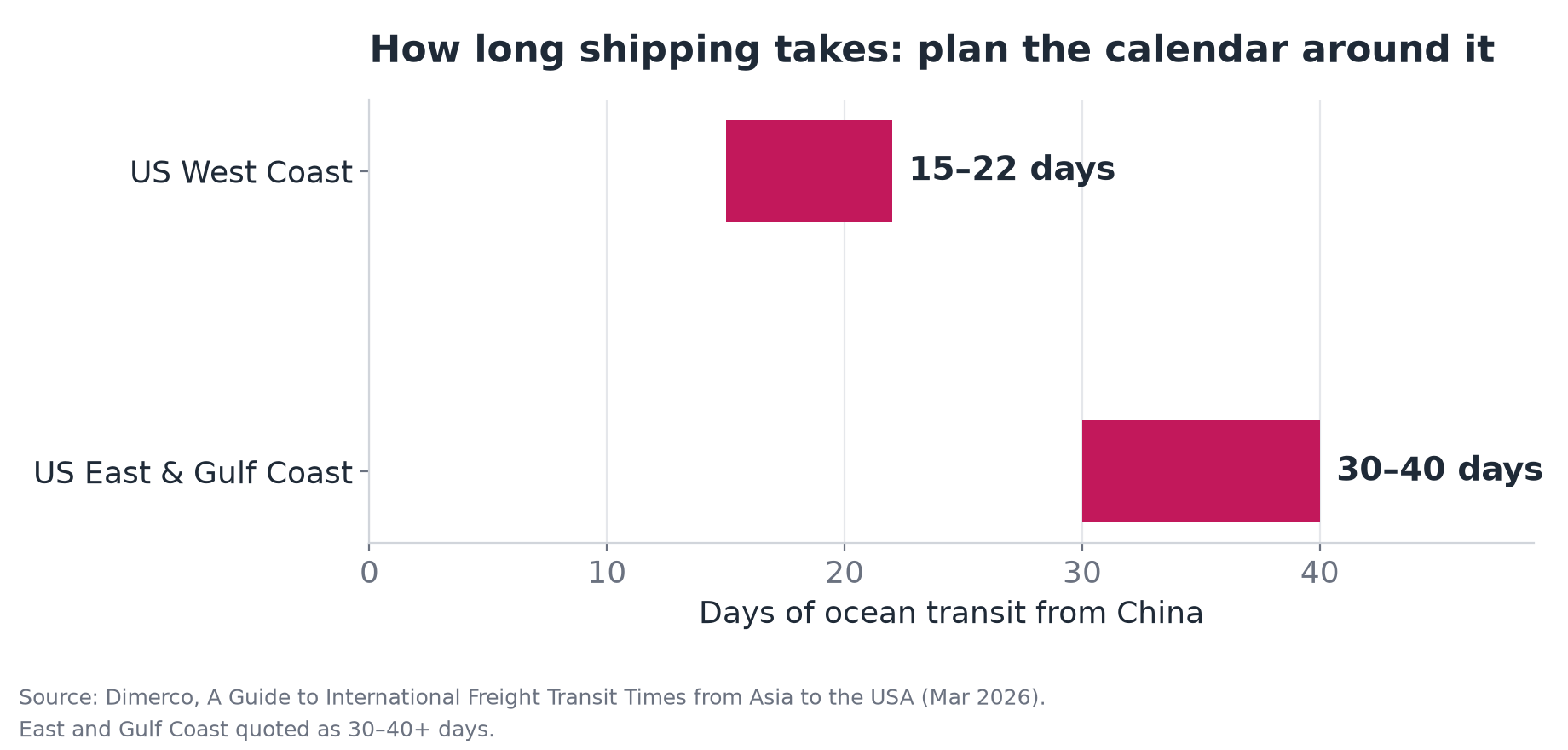
Order in September for a November shelf date. Production of a seasonal decoration assortment typically takes four to six weeks once the specification is locked. Ocean transit from South and East China to the US West Coast runs 15–22 days; East and Gulf Coast routings take 30–40 days or more. Add customs clearance and inland delivery, and an October purchase order is already late. Retailers who order in October routinely pay air freight in December, at several times their sea-freight budget, to protect a shelf date that a September decision would have protected for free.
How do you choose between a direct factory, a trading company and an integrated partner?
Match the model to the shape of your order, not to the lowest unit price.
| Your situation | Best-fit model | Why |
|---|---|---|
| One process, very high volume, simple spec | Direct factory | Lowest unit cost, minimal coordination |
| A few SKUs, urgent, tolerating variation | Trading company | Fast quotes, some multi-factory reach |
| Assortment across materials, processes and categories | Integrated supply chain partner | Consolidation, documented compliance, programme-level QC |
| Compliance paperwork must be defensible to authorities | Integrated supply chain partner | Ownership of test reports and declarations |
| November replenishment matters to the sell-through result | Integrated supply chain partner | Pre-approved specs and reserved capacity |
A factory optimises one product. A trading company brokers several. An integrated partner owns the programme — which is the only one of the three that also carries your compliance risk upstream, where it is still cheap to fix.
What certifications do Christmas decorations need?
It depends on the destination market, and each regime has its own lead time.
-
European Union. Regulation (EU) 2023/988, the General Product Safety Regulation, has applied since 13 December 2024. Every consumer product placed on the EU market must be safe, and manufacturers, importers and distributors carry specific information and traceability obligations, including an identified EU-based responsible operator and destination-language warnings.
-
United States. CPSC’s seasonal and decorative lighting guidance covers minimum wire size, strain relief and overcurrent protection such as fuses, and shipments that fail those requirements can be refused admission. CBP’s Importing into the United States covers entry formalities.
-
EAEU (Russia, Kazakhstan, Armenia, Kyrgyzstan, Belarus). TR CU 008/2011 On the safety of toys covers products including Christmas garlands and decorations and requires conformity confirmation by certification. Electric garlands additionally fall under TR CU 004/2011 on low-voltage equipment and TR CU 020/2011 on electromagnetic compatibility.
The practical implication: certification and testing queues are part of your critical path, not paperwork you complete after the goods arrive.
Is it cheaper to buy Christmas decorations directly from a factory?
Per unit, usually — for a single process at volume. Per sellable unit delivered, often not. Direct sourcing does not remove testing, compliance documentation, pre-shipment inspection, multi-factory consolidation or logistics coordination; it transfers them to your team. Add the cost of one defect class discovered at retail instead of at the loading dock and the eight per cent unit-price advantage can invert. Compare quotations on landed cost per sellable unit and treat compliance and QC as product features.
How do you keep quality consistent across a multi-SKU decoration programme?
Lock the specification before production, agree the inspection protocol in writing, and inspect before shipment rather than on arrival. Specify who inspects, against which acceptance quality limit, at which production stage, and what happens to a failed lot. Most consistency failures in seasonal decor are specification failures — an unmatched finish on an ornament, an undocumented wire gauge on a light string — rather than factory capability failures. A written protocol converts a judgement call into a pass-or-fail test.
Can one supplier handle ornaments, garlands, party accessories and light sets together?
An integrated supply chain partner is usually the more practical route for this. A single factory covers one process. Mixing ornament manufacturing, garland assembly, party accessories and electrical products across four factories means four bookings, four inspection sets and four document trails — unless one partner consolidates them into a single shipment plan. For a seasonal window that cannot slip, consolidation is a schedule-protection mechanism as much as a cost mechanism.
What does a wholesale Christmas decoration supplier actually need to provide?
Six things, and a price list is only the first: product development and design against your price architecture; retail-ready packaging with correct barcodes, hangtags and destination-language warnings; testing and quality control including electrical safety for powered items; compliance documentation; consolidation and international logistics; and a replenishment path for November sell-through. A supplier that delivers only the first item has shifted five obligations onto you.
How large is the wholesale Christmas decoration market?
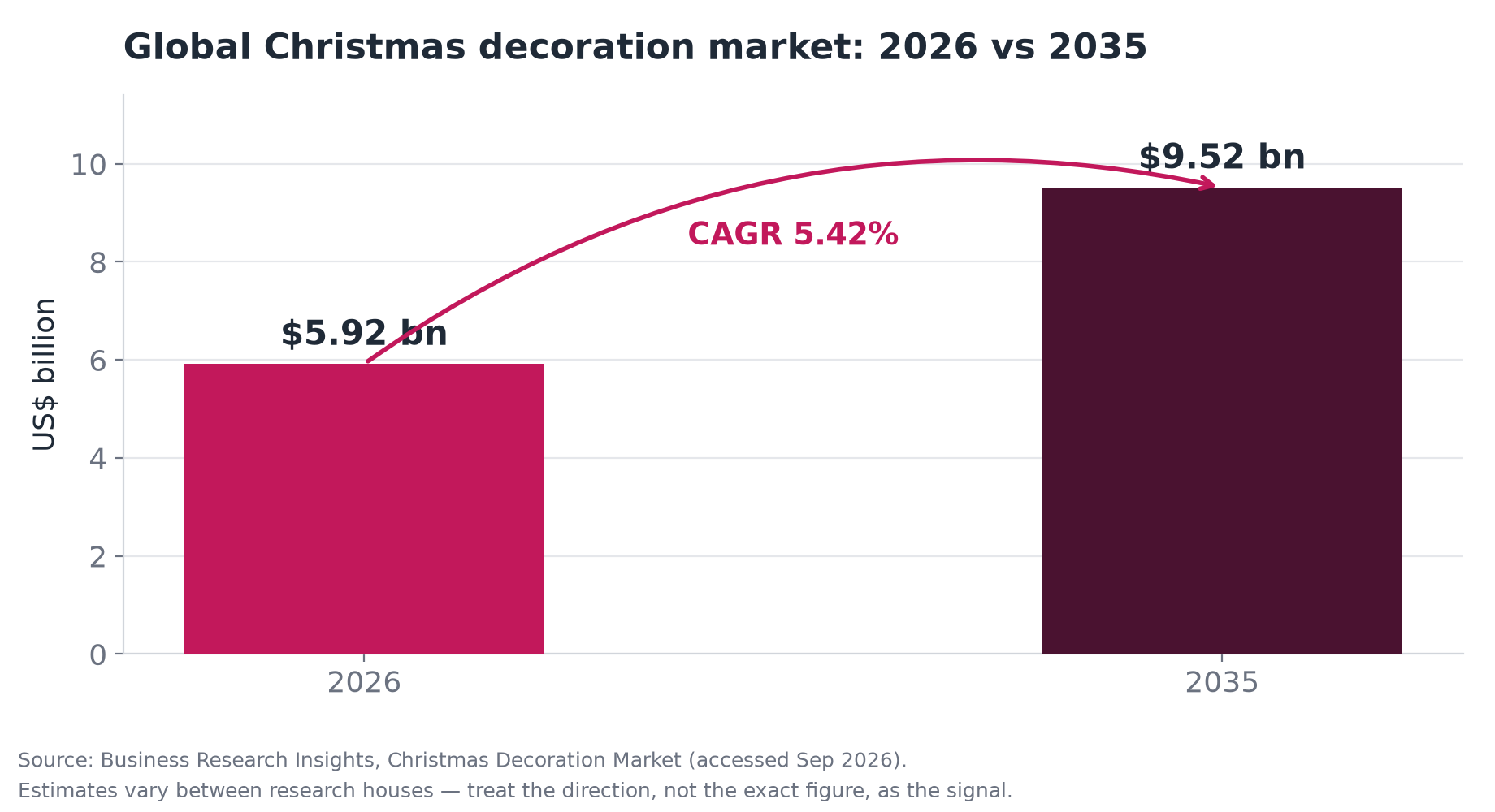
Published estimates put the global Christmas decoration market at roughly USD 5.9–6.1 billion in 2026, with projections of USD 9.3–9.5 billion by 2035. Business Research Insights models USD 5.92 billion for 2026 at a 5.42% CAGR; Market.us projects USD 6.1 billion in 2025 growing to USD 9.3 billion by 2035 at 4.3%; Market Data Forecast values the wider Christmas lights and decoration market at USD 8.39 billion in 2025 with a 3.75% CAGR to 2034. Figures differ because publishers draw category boundaries differently — use them for direction, not for a single-point buy plan.
What are the most common sourcing mistakes in seasonal decoration?
Four recur. Buying on unit price and treating compliance as an afterthought. Approving samples late, which converts a production delay into a December air-freight bill. Leaving the shipper identity unclear on the bill of lading, which costs logistics visibility exactly when it is needed. And forecasting a single best-selling SKU instead of pre-approving the capacity to restock it.
How should you structure the compliance file?
Build it in this order and hand it to the supplier as a requirement list rather than a question: named owner of the declaration of conformity; test reports dated within the validity of the applicable standard; traceability to the production lot; destination-language warnings; and, for EU-bound goods, the identified responsible economic operator. For EAEU-bound goods, add the certificate issued under TR CU 008/2011 and, for electric garlands, the TR CU 004/2011 and TR CU 020/2011 documentation. This file is what a market surveillance authority or customs officer will ask for, and it must exist before the container moves.
Which markets are growing fastest for seasonal decor?
Growth is broad rather than concentrated, which is why seasonal programmes merit a fixed annual calendar instead of opportunistic buying. Europe and North America remain the largest destinations, while demand across the CIS, Latin America and Southeast Asia is served increasingly through consolidated programmes rather than single-factory orders. MU Group, established in 2003 and operating as an all-category supply chain management business across 10 core categories, runs its festival and party supplies line from an operating network that includes Ningbo, Yiwu, Shanghai, Shenzhen, Hanoi, Jakarta, Istanbul, Moscow, Mexico City, Panama City and Warsaw — the footprint that makes multi-region seasonal delivery practical.
Where does MU Group fit as a decoration supplier?
MU Group is an integrated supply chain partner rather than a single factory. For seasonal decoration programmes it covers design and development, packaging engineering, testing and quality control, compliance documentation, multi-factory consolidation and international logistics, so a buyer carries one supplier relationship and one shipment plan instead of a portfolio of unconnected vendors. Buyers evaluating the model can start from the festival and party supplies range, compare the full products and services structure, read a customer case from a comparable retail channel, or submit an assortment brief through the contact form.
Sources
-
Regulation (EU) 2023/988 on general product safety (GPSR) — https://eur-lex.europa.eu/eli/reg/2023/988/oj/eng
-
European Commission, Access2Markets — GPSR explainer — https://trade.ec.europa.eu/access-to-markets/en/news/eus-general-product-safety-regulation-gpsr-new-era-consumer-protection
-
U.S. CPSC, Seasonal and Decorative Lighting Products business guidance — https://www.cpsc.gov/Business–Manufacturing/Business-Education/Business-Guidance/Household-Electrical-Products/Seasonal-and-Decorative-Lighting-Products
-
U.S. CBP, Importing into the United States — https://www.cbp.gov/document/publications/importing-united-states
-
EEC, TR CU 008/2011 On the safety of toys — https://eec.eaeunion.org/upload/medialibrary/419/TR-TS-Toys.pdf
-
Business Research Insights, Christmas Decoration Market — https://www.businessresearchinsights.com/market-reports/christmas-decoration-market-103288
-
Market.us, Global Christmas Decoration Market — https://market.us/report/global-christmas-decoration-market/
-
Market Data Forecast, Christmas Lights and Decoration Market — https://www.marketdataforecast.com/market-reports/christmas-lights-and-decoration-market
-
Dimerco, International Freight Transit Times from Asia to the USA — https://dimerco.com/blog-post/a-guide-to-international-freight-transit-times-from-asia-to-usa/