
Quick answer: Canton Fair Phase 2 runs from 23 to 27 October 2026 at the China Import and Export Fair Complex in Pazhou, Guangzhou. It is the Quality Home Life phase, and it covers the general merchandise a retail buyer actually builds a range from: housewares, kitchenware and tableware, glassware, daily-use and craft ceramics, home decorations, garden products, festival products, gifts and premiums, watches and eyewear, fashion accessories, woven and rattan-iron crafts, building and decorative materials, sanitary and bathroom equipment, furniture, and integrated housing and courtyard facilities. If your buying list is consumer goods for resale rather than machinery or apparel, this is your phase. Phase 1 is industrial and electronic; Phase 3 is textiles, apparel, footwear, bags, office supplies, medical products and food.
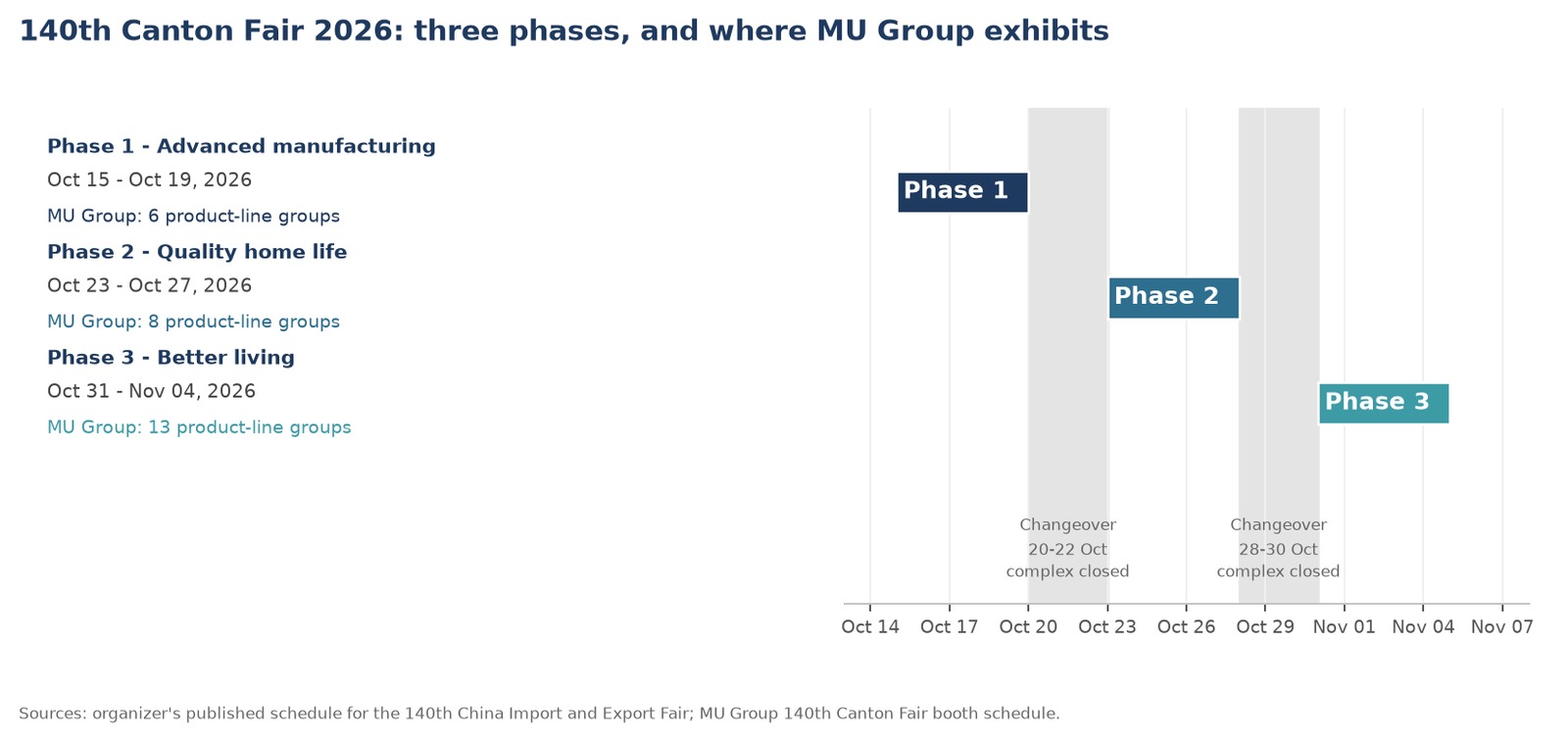
The fair is open for five days, and the complex is closed on 20–22 October and again on 28–30 October while the stands are rebuilt for the next phase. That single fact shapes most of the planning advice below: what you can see, who you can meet, and what you have to arrange before you arrive all depend on working inside a five-day window that does not reopen later in the same trip.
Canton Fair Phase 2 dates, and the two closed windows around them
The 140th session is split into three phases with changeover breaks between them. The dates below follow the organiser’s published schedule; confirm them against the official Canton Fair exhibition schedule before you book travel, because venue arrangements can be adjusted at short notice.
| Phase | Dates | Theme | Product focus |
|---|---|---|---|
| Phase 1 | 15–19 October 2026 | Advanced manufacturing | Electronics, appliances, lighting, machinery, tools, hardware, vehicles, new energy |
| Changeover | 20–22 October 2026 | — | Complex closed, stands rebuilt |
| Phase 2 | 23–27 October 2026 | Quality Home Life | Housewares, gifts, decorations, ceramics, glassware, furniture, building materials |
| Changeover | 28–30 October 2026 | — | Complex closed, stands rebuilt |
| Phase 3 | 31 October–4 November 2026 | Better Living | Textiles, apparel, footwear, bags, office supplies, medical products, food |
Three practical consequences follow, and they are the ones buyers most often discover too late.
First, the changeover days are not spillover days. The complex is closed and the stands are being dismantled and rebuilt, so no supplier is on a stand and no meeting can be held in the halls between phases. A buyer who assumes 22 October can be used for a follow-up conversation, or that a Phase 1 supplier can be seen again on the way into Phase 2, will lose a day.
Second, if your list genuinely spans two phases, you are planning two visits, not one. A buyer sourcing kitchenware and apparel cannot compare those ranges side by side in a single week, because the apparel sections do not open until 31 October.
Third, the opening morning carries the heaviest queue for badges and security. Buyers travelling a long distance often treat the first morning as a full working day and then find that the first productive hour is later than expected. Build the day around the afternoon, and put the meetings you cannot move on day two.
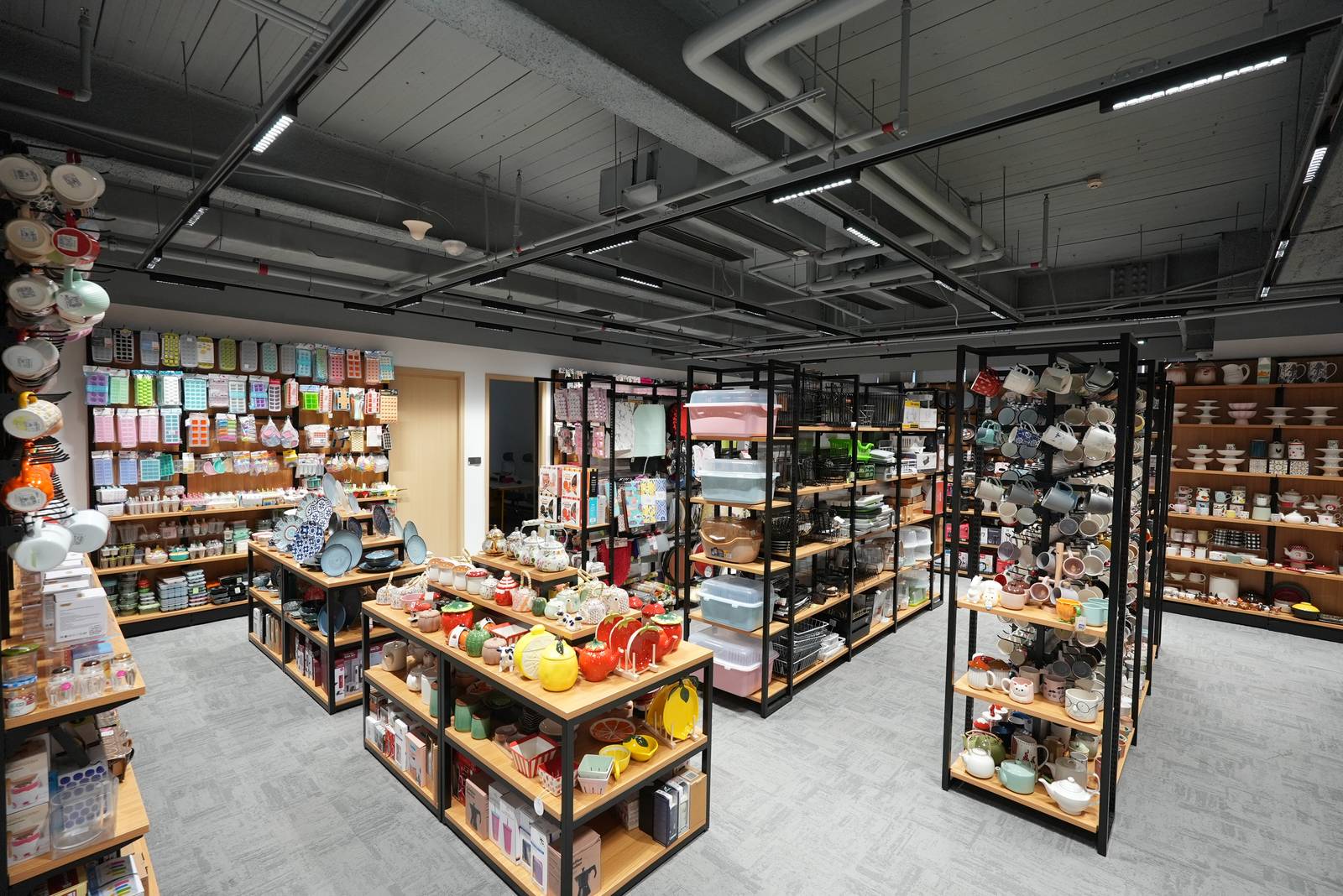
The changeover is also the window when the halls are closed but the city is not. MU Group’s showroom occupies the 8th and 11th floors of Block A in the Canton Fair Tower beside the complex — No. 679 Fengpu Middle Road, Haizhu District, Guangzhou — and the Guangzhou operation centre sits in the same building. The two floors carry samples across the group’s product lines rather than a single category, so a buyer holding a mixed list can compare ceramics, glassware, housewares, kitchen ranges and seasonal items in one stop instead of crossing four areas of the complex. Visiting hours are 08:00 to 11:00, which is a narrow slot: arrange the visit through the contact page and confirm which categories you need on the floor that day.
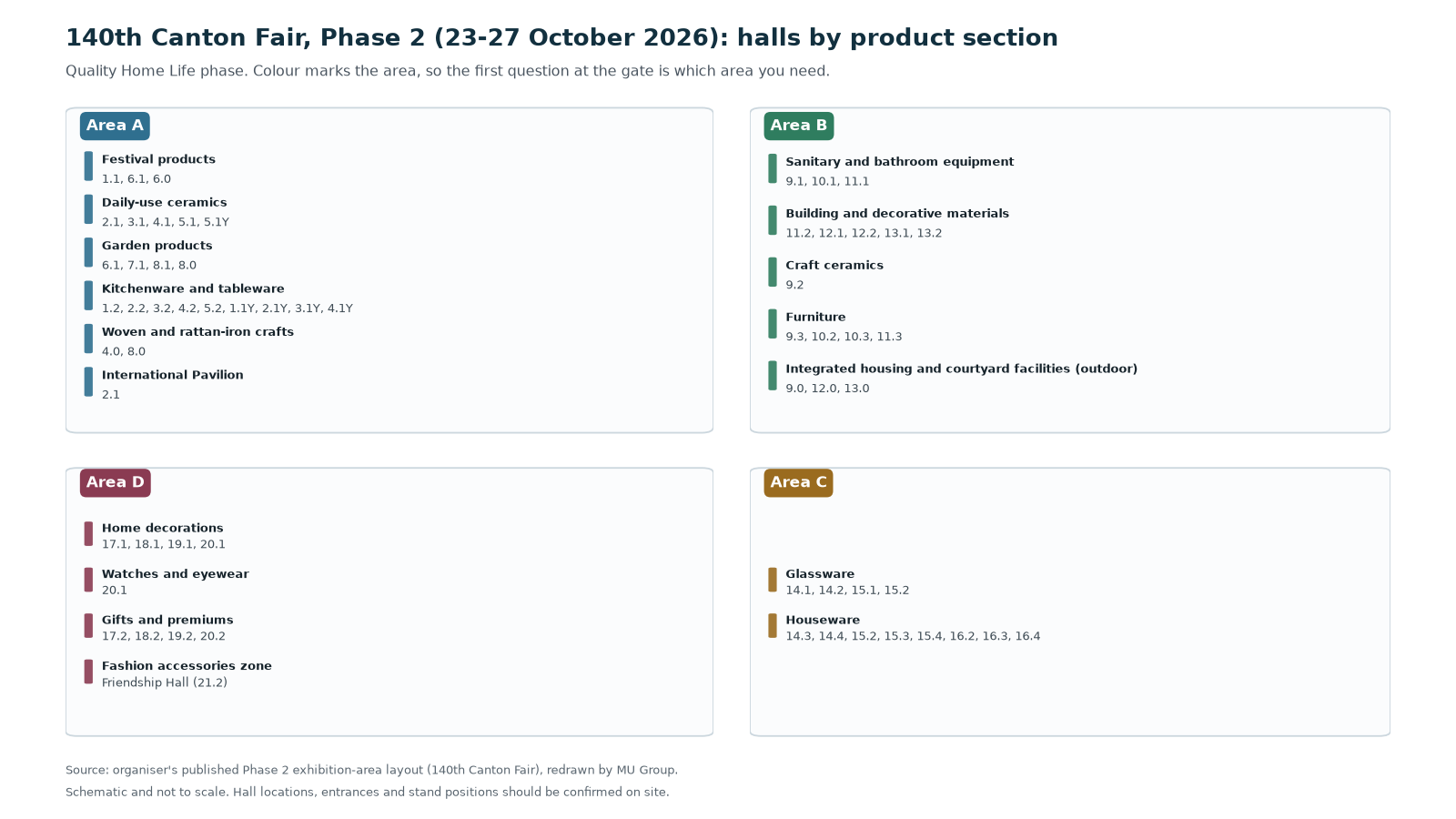
Phase 2 hall map: where each of the sixteen product sections sits
Phase 2 is the broadest general-merchandise phase of the fair, and it is broad in a specific way: almost everything in it is a finished consumer product that has to sit on a shelf, carry a label and survive a shipping container. That is what makes it useful to retail buyers and what makes it hard to cover in five days.
The sections fall into five buying clusters — table and kitchen, home and decoration, garden and outdoor living, build and furnish, and gift and personal. Knowing which cluster you are in determines how you sequence the visit, because the questions you ask a ceramics supplier and the questions you ask a furniture supplier are not the same questions.
The official layout also places every Phase 2 section in one of four areas — A, B, C or D — and which area you need is the first decision of the day, before any hall number. The figure below is the organiser’s Phase 2 layout redrawn in English; the table that follows carries the same information as text, so the page stays usable for anyone reading it on a phone.
| Section | Area and halls | What usually decides the comparison |
|---|---|---|
| Daily-use ceramics | Area A — 2.1, 3.1, 4.1, 5.1, 5.1Y | Chip resistance, glaze consistency, packing method |
| Kitchenware and tableware | Area A — 1.2, 2.2, 3.2, 4.2, 5.2, 1.1Y, 2.1Y, 3.1Y, 4.1Y | Material grade, set composition, retail packaging |
| Glassware | Area C — 14.1, 14.2, 15.1, 15.2 | Breakage rate in transit, packing, finish consistency |
| Houseware | Area C — 14.3, 14.4, 15.2, 15.3, 15.4, 16.2, 16.3, 16.4 | Assortment breadth, price ladder across SKUs |
| Home decorations | Area D — 17.1, 18.1, 19.1, 20.1 | Seasonal relevance, colour and finish matching |
| Craft ceramics | Area B — 9.2 | Hand-finish variation, packing, repeatability |
| Woven and rattan-iron crafts | Area A — 4.0, 8.0 | Shape retention, moisture, carton volume |
| Festival products | Area A — 1.1, 6.1, 6.0 | Season timing, artwork approval, packing sets |
| Garden products | Area A — 6.1, 7.1, 8.1, 8.0 | Weather resistance, weight, flat-pack design |
| Integrated housing and courtyard facilities | Area B — 9.0, 12.0, 13.0 (outdoor) | Specification, transport volume, site assembly |
| Building and decorative materials | Area B — 11.2, 12.1, 12.2, 13.1, 13.2 | Weight, surface finish, breakage and freight cost |
| Sanitary and bathroom equipment | Area B — 9.1, 10.1, 11.1 | Compatibility, packing, documentation |
| Furniture | Area B — 9.3, 10.2, 10.3, 11.3 | Flat-pack design, carton volume, hardware quality |
| Gifts and premiums | Area D — 17.2, 18.2, 19.2, 20.2 | Customisation, per-unit packaging, repeatability |
| Watches and eyewear | Area D — 20.1 | Labelling, packaging, finish consistency |
| Fashion accessories | Area D — Friendship Hall, 21.2 | Colour range, hardware quality, per-piece cost |
Two things are worth noticing in that table. The first is how often packing and transport volume decide the outcome. For ceramics, glassware, furniture and woven products, a quotation that looks attractive per piece can stop being attractive once carton volume and breakage are priced in, and that calculation is much easier to do while the supplier is standing in front of you than three weeks later by email.
The second is that the clusters do not follow the area boundaries. Areas A and C carry most of the table and kitchen ranges, Area B carries furniture, building materials, sanitary ware and craft ceramics, and Area D carries decorations, gifts, watches and fashion accessories. A buying list that mixes kitchenware with gifts therefore involves crossing the complex, and the route has to be built around areas rather than around the order of a catalogue.
Area A also holds the International Pavilion in hall 2.1, alongside the daily-use ceramics halls. Because the sections are rebuilt between phases, no map from Phase 1 or from a previous session should be reused: the layout above is the Phase 2 layout, and entrances, signage and stand positions should still be confirmed on the day.
Where buyers most often put a Phase 2 product in the wrong phase
The most expensive mistake in fair planning is not choosing the wrong supplier. It is booking the wrong week. Several product families sit close enough to a neighbouring phase that buyers regularly arrive five days early or five days late.
| If your product is | It is in | The neighbour that causes the confusion |
|---|---|---|
| Ceramic tableware and dinnerware | Phase 2 | Kitchen appliances, which are Phase 1 |
| Glassware and decorative ceramics | Phase 2 | Home textiles, which are Phase 3 |
| Fashion accessories | Phase 2 | Garment accessories and trims, which are Phase 3 |
| Bags, cases and luggage | Phase 3 | Often assumed to sit with fashion accessories |
| Sanitary and bathroom equipment | Phase 2 | Personal care and bathroom products, which are Phase 3 |
| Gifts and premiums | Phase 2 | Toys, which are Phase 3 |
| Furniture | Phase 2 | No furniture section in Phase 3 |
The working rule is to classify the item by how it will be merchandised, not by what it is made of. A ceramic vase sold as a home decoration and a ceramic mug sold as part of a dinnerware set are both Phase 2, but a ceramic piece sold as a gift item is assessed differently again — by its box, its artwork and its repeatability, not by its body material. When a product genuinely straddles two phases, the practical approach is to anchor the trip on the phase that carries the larger share of your range and handle the remainder through supplier meetings arranged outside the fair calendar.
If you are unsure, the official product index is the reference, and the organiser publishes the section lists for each phase. Checking one item takes a few minutes; discovering it on arrival costs a week.
Planning a Phase 2 route around the official layout
A five-day phase is enough time if the route is planned and too little if it is not. The complex is large, security checks take time, and the walk between two distant sections can consume most of an hour that was meant for a meeting.
Work in this order.
Mark your clusters, not your suppliers. Start from the five clusters above and mark the sections that matter to your range. Suppliers come second, because you will not know which stands are worth your time until you are standing in the right section.
Sequence by cluster, and keep the day contiguous. If your range is table and kitchen plus home decoration, those two clusters are adjacent in buying logic and usually adjacent enough in the complex to be walked in one block. Do not interleave a garden products appointment into a ceramics morning unless there is a commercial reason to.
Book meetings in two blocks a day. One morning block and one afternoon block leaves room for the walk, the badge queue, photography and note-taking. Buyers who book five back-to-back appointments usually finish three.
Keep one pre-screened alternative per slot. Stands change, meetings run late, and a section can be busier than expected. An alternative supplier in the same cluster protects the day.
Record every conversation in the same fields. Stand or section reference, supplier name, product code, quotation basis, the supplier’s stated minimum, sample status, packaging, the supplier’s stated lead time, open quality questions and the next action. Photograph the product together with its identifying label so the photo can be matched to the record later.
MU Group’s own Phase 2 presence is listed by product line and stand in the 140th Canton Fair booth guide, which is the reference to use rather than a stand number remembered from a previous session.
The buyer brief to prepare before 23 October
The single largest determinant of what you get out of Phase 2 is what you bring into it. A written brief turns a stand conversation into a comparison; without one, you spend the fair collecting catalogues that cannot be compared with each other.
A usable brief for a consumer product usually contains:
-
The product, described precisely. Dimensions, material or material grade, finish, colour reference, and the components included in the set. A photo of a competitor product is useful, but only alongside a written specification.
-
The retail context. Target retail price band, the channel you sell through, and the shelf or pack format the product has to fit. Suppliers quote differently once they understand the price band they are being asked to hit.
-
Packaging and labelling. Retail box or polybag, artwork ownership, barcode and label position, and the language required on the pack. Packaging is a cost line, and leaving it out produces quotations that cannot be compared.
-
Order structure. How many SKUs you intend to carry and, for each, the quantity you are planning. This is the information a supplier needs before stating a minimum, and it is the information buyers most often withhold.
-
Destination and terms. The country the goods will be imported into, and the Incoterm you want quoted, so that every supplier prices the same scope.
-
Documents you need the supplier to provide. State the list you require rather than assuming it exists, and confirm with your own compliance adviser which documents apply to your product and destination.
-
Sample expectation. Whether you need a stock sample, a customised sample, or both, and what you expect the sample to prove.
Bring the brief on paper and in a form you can send from your phone. The stands are loud, and a supplier who receives the brief by message while you are still in the hall will usually come back with a more specific answer than one who writes it down from memory.
Comparing Phase 2 quotations on the same basis
Most quotation confusion at the fair is not a pricing dispute. It is two suppliers answering two different questions. Before you compare anything, make each supplier state the basis of the number.
| What to pin down | Why it changes the comparison |
|---|---|
| Unit basis | Per piece, per set and per carton produce very different totals for the same product |
| Incoterm | An ex-works figure and an FOB figure are not comparable, and neither includes the same costs |
| Packaging included or not | Retail packaging, inner cartons and export cartons are separate cost lines |
| Minimum quantity basis | A minimum per SKU and a minimum per order behave differently across a multi-SKU range |
| Sample charge and tooling | Sampling and any mould or artwork cost may sit outside the unit price |
| What is excluded | Freight, insurance, duties and destination charges are usually outside the supplier’s number |
Two habits make the comparison reliable. Ask each supplier to write the basis next to the number rather than to state a price, and ask them to name their own minimum quantity, lead time and payment terms in writing. MU Group does not publish minimums, lead times or prices for suppliers it works with, because those belong to the individual producer and the individual order; what can be done is to collect the terms from each supplier on the same template so the differences are visible.
The same discipline applies to quality. A sample seen at a stand proves what the supplier can present, not what a production run will deliver. Note what the sample is, whether it is a stock item or made for you, and which points you would need to verify before a bulk order — that note becomes the basis of the inspection plan later.
Turning five days into a sourcing plan
A fair visit produces supplier contacts, samples and notes. A sourcing plan produces one shipment that arrives correctly. The gap between the two is where most first orders are lost, and it is usually a consolidation problem rather than a product problem.
Phase 2 makes that gap wider than usual, because a retail range assembled at this fair typically comes from several suppliers in several cities, and the goods have to be collected, checked and consolidated before they can ship. The work after the fair therefore looks like this:
-
Consolidate the supplier list against the brief. Keep the suppliers who quoted on the same basis and can answer the quality questions; set aside the ones whose quotation cannot be normalised.
-
Confirm the sample round. Agree what is being sampled, against which specification, and what the approval criteria are.
-
Define the inspection points. Decide what is checked before production, during production and before shipment, and who is responsible for each.
-
Plan the consolidation. Multi-supplier orders need a collection point, a carton-level check and a loading plan, or the container is built from whatever arrives first.
-
Confirm the documents. Import documentation, labelling and any product-specific requirements should be settled with your own compliance adviser before production, not after.
This is the part of the process where a sourcing partner is useful rather than decorative. MU Group is a procurement and supply chain service provider, not a manufacturer, and the work it can take on is the coordination around the product: market research and data analysis, product development and design support, procurement management, packaging design, product testing and quality control, international logistics coordination and after-sales support. The exact scope depends on the product, the destination and the terms, and should be confirmed before the project starts rather than assumed. The Canton Fair buyer support page lists the on-site services — booth guidance, showroom access, Guangzhou market assistance, interpreting and transport coordination — and buyers who need follow-up in other sourcing cities can check the branch office network for Guangzhou, Ningbo, Shantou and Yiwu. The broader service scope is set out under what MU Group does.
Frequently asked questions about Canton Fair Phase 2
What are the Canton Fair Phase 2 dates in 2026?
Phase 2 of the 140th Canton Fair runs from 23 to 27 October 2026 at the China Import and Export Fair Complex in Pazhou, Guangzhou. The complex is closed on 20–22 October and on 28–30 October for the changeovers, so no stands are open between phases.
Which products are in Canton Fair Phase 2?
Phase 2 covers housewares, kitchenware and tableware, glassware, daily-use ceramics, craft ceramics, home decorations, garden products, festival products, gifts and premiums, watches and eyewear, fashion accessories, woven and rattan-iron crafts, building and decorative materials, sanitary and bathroom equipment, furniture, and integrated housing and courtyard facilities. It is the general merchandise phase, as distinct from the industrial focus of Phase 1 and the textile and apparel focus of Phase 3.
Does MU Group exhibit in Phase 2?
Yes. MU Group exhibits across all three phases, with eight product-line groups in Phase 2. The product lines and stand numbers are published in the 140th Canton Fair booth guide, which is updated for the current session.
Do I need an appointment to visit a stand in Phase 2?
No appointment is needed to walk a stand, but a pre-arranged meeting helps where you need a specific product reviewed by someone who can answer specification questions. Buyers with a multi-category list usually book the priority meetings in advance and leave the rest of the route open.
Can MU Group help with supplier meetings during Phase 2?
Booth guidance, showroom access, market assistance and interpreting are arranged against your product list and the schedule, so confirm them in advance through the contact page rather than at the stand. If your list also spans the other phases, say so at the start — agreeing which trip makes sense is more useful than planning two half-visits.