
A supplier scorecard template earns its place when it changes a sourcing decision. A spreadsheet that averages every result into one high score can conceal a late shipment, a recurring defect, or a missing compliance document. Buyers need to see which performance area is changing, what evidence supports the rating, and who owns the next action.
For importers managing several product lines or suppliers, a useful scorecard turns order history into a repeatable review. APQC recommends balancing delivery and service, quality and compliance, cost and value, process efficiency, and risk and sustainability. It also advises keeping a single dashboard to about ten measures or fewer, so teams can focus on indicators they can maintain and act on. APQC’s supplier scorecard guidance provides a useful reference for building that structure.
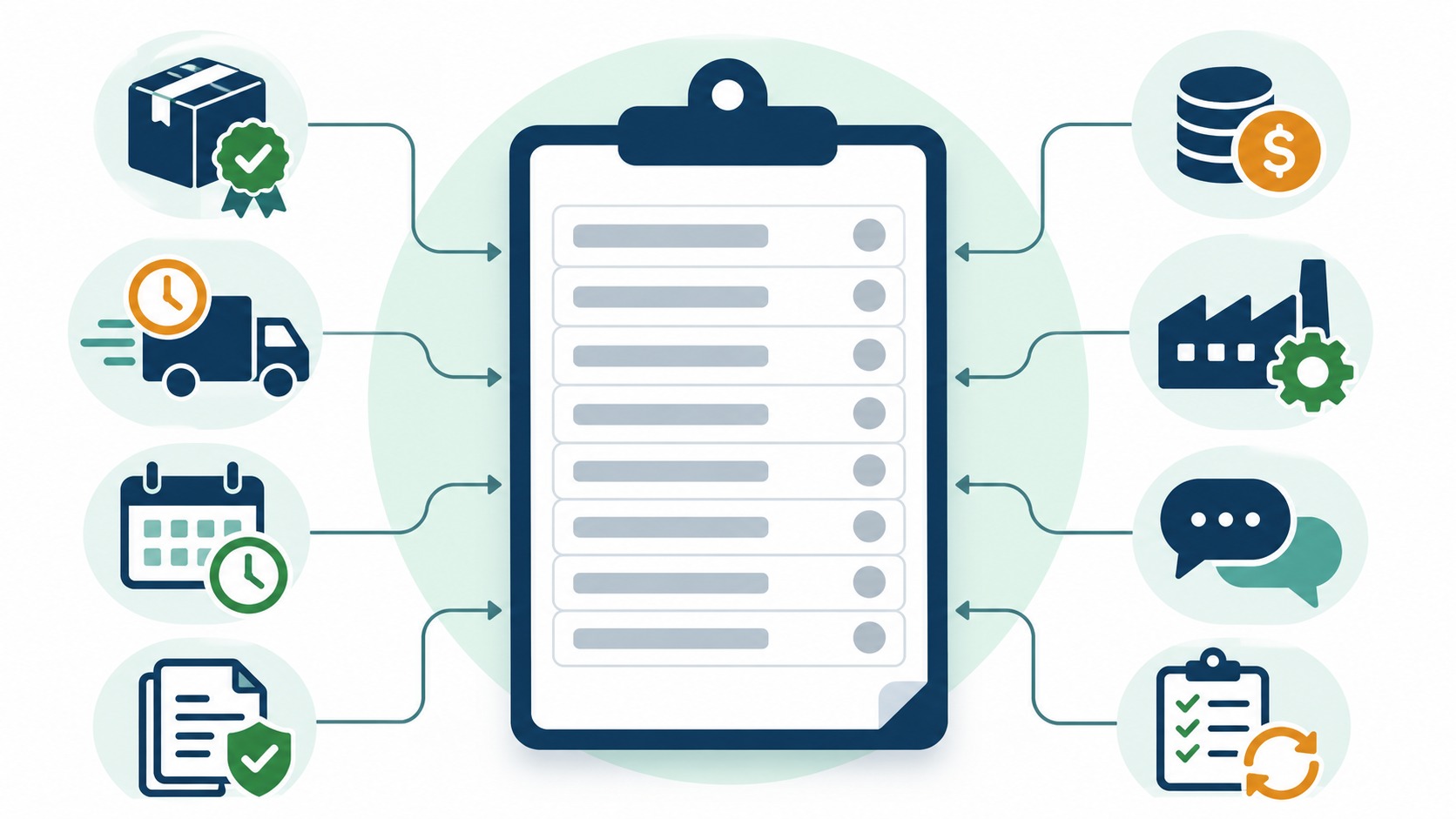
What a supplier scorecard should help you decide
A factory audit records what a supplier can do at a point in time. A scorecard tracks how the supplier performs across real orders. The two tools answer different questions: an audit helps buyers assess capability and controls before committing, while a scorecard helps them decide whether performance remains suitable as the product mix, order volume, and delivery requirements change. MU Group’s factory audit guide explains how buyers can connect audit findings to an initial sourcing decision.
Set the decisions before choosing the metrics. A review may lead a team to keep the current allocation, ask for a corrective action, increase monitoring, reduce future volume, or qualify another source. If the scorecard does not connect to one of these decisions, it can become a reporting task with no operational effect.
Keep the scorecard at a useful level of detail. A supplier may perform well on one product and poorly on another because materials, production steps, or specifications differ. Track results by supplier and product category, and split out individual SKUs when a quality or compliance risk requires it. That makes the data more useful than a single rating for the supplier as a whole.
Supplier scorecard template: eight metrics to track
The table below is a starting framework for importers. Define each measure before the order begins, use the same unit of analysis across suppliers, and retain the source evidence alongside the score.
| Metric | What to measure | Evidence to retain |
|---|---|---|
| Quality conformance | Defects, inspection results, rework, and claims against the agreed product specification | Approved specification and sample, inspection records, rework notes, returns or claims |
| On-time delivery | Share of purchase-order lines or shipments received by the confirmed delivery date | Purchase order, agreed date changes, shipping records, and receiving records |
| Lead-time reliability | Difference between the agreed and actual lead time, plus the share of orders within the agreed window | Order release date, production milestones, shipment date, and receipt date |
| Product compliance and documents | Whether required test reports, certificates, labels, and shipment documents are complete, current, and applicable | Market-specific requirements, approved document versions, and review records |
| Commercial accuracy | Variance from approved prices and terms, quote completeness, and changes to cost assumptions | Approved quotation, change approvals, invoices, packing details, and freight assumptions |
| Capacity and production readiness | Whether accepted orders and production milestones match the supplier’s confirmed plan | Capacity plan, production updates, milestone records, and disclosed subcontracting |
| Communication and responsiveness | Time to acknowledge requests, provide required information, and escalate an issue through the agreed channel | Timestamped correspondence, document requests, and issue logs |
| Corrective action and recurrence | Time to contain and close a problem, and whether the same issue returns after the fix | Nonconformance records, root-cause analysis, corrective-action evidence, and follow-up checks |
For the quality row, keep inspection evidence tied to the exact SKU, specification, and purchase order. A passing result on one sample or product does not establish consistent performance across every item in a multi-SKU order. MU Group’s article on SKU-level quality control for retail importers discusses why the unit of analysis matters when retailers manage repeat orders.
Cost also needs a consistent basis. Compare like with like: unit, set, or carton prices; the same order quantity; and the same assumptions for packaging, transport, and other charges. A lower quoted unit price may not represent lower total cost if the quote leaves important cost components unresolved. Record approved changes and their reasons instead of treating every price movement as a supplier failure.
Risk and sustainability measures can be added when they affect the product, contract, or buyer’s reporting obligations. Examples include disclosure of critical subcontracting, continuity arrangements for constrained inputs, or required sustainability data. Keep the dashboard focused; APQC’s guidance suggests selecting a small set of measures that decision-makers can reliably collect and use.
Score evidence consistently and keep critical gates visible
Before assigning a number, write down what each rating means. A simple five-point scale can work when every buyer uses the same anchors. The following is an illustrative rubric, not an industry standard:
| Score | Example meaning |
|---|---|
| 1 | A critical requirement is missed or the required evidence is absent |
| 2 | Performance is below the agreed baseline or misses recur |
| 3 | The agreed baseline is met with adequate evidence |
| 4 | Performance is consistent and issues are handled within the agreed process |
| 5 | Performance is predictable, well documented, and contributes to measurable improvement |
Do not let a weighted average erase a hard failure. A missing product-safety document, an unresolved critical defect, or a delivery failure on a time-sensitive launch may require a separate pass-or-fail decision. Set those gates in advance, then use the weighted score to compare performance in areas where trade-offs are acceptable.
Weights should reflect the product and the buying plan. For a seasonal item, delivery reliability may carry more weight because a missed selling window can undermine the order. For a product with strict market requirements, compliance and quality may be prerequisites. A stable replenishment item may place more emphasis on repeat quality, lead-time reliability, and commercial consistency. The right balance depends on the buyer’s requirements and the supplier’s role.
Consider a hypothetical example: Supplier A has strong quality results and competitive pricing but repeatedly misses the confirmed window for a seasonal product. Its average score may look acceptable if communication and price receive high ratings. A scorecard that shows each metric separately lets the buyer see that the order may not fit this product’s schedule, even if the supplier remains suitable for a different category.
Make the scorecard part of a review cycle
Agree on the metric definitions, evidence sources, decision gates, and review owner before production starts. Buyers and suppliers should understand which date counts as the commitment, which document version is current, and how a change to the order affects the measure. Clear definitions reduce disputes later because both sides can trace a score back to the same record.
Collect information from the order process rather than reconstructing it from memory. Purchase orders, approved samples, inspection records, production milestones, shipment documents, invoices, and customer claims each reveal a different part of performance. Keep the source and reporting period beside the score, and note when the data is incomplete.
Review trends as well as the latest result. A supplier may have missed one delivery because the buyer changed the specification late; a repeated pattern of late milestones points to a different problem. Each review should identify the cause, the action, its owner, and a due date. The next review can then confirm whether the change worked.
Review frequency should follow supplier criticality and risk. APQC recommends more frequent and collaborative reviews for strategic or critical suppliers than for routine transactional suppliers. A team might review a critical source around production milestones and shipment release, while reviewing a stable, low-risk source on a less frequent cycle. Choose a cadence the team can sustain.
Common scorecard mistakes to avoid
One common mistake is changing the rules after the results arrive. If the target, denominator, or definition of “on time” changes from one review to another, a score trend stops being comparable. Keep definitions stable and document any agreed change.
Another is mixing separate causes into one rating. A late shipment can result from supplier capacity, a buyer’s late approval, a carrier delay, or a changed specification. Record the cause and the responsible process before assigning a corrective action. Otherwise, the scorecard can encourage the wrong fix.
Finally, avoid adding measures that no one can maintain. A detailed template only helps when the team can collect reliable evidence and assign follow-up. Start with the measures tied to the next buying decision, then add a field only when it answers a recurring question or a material risk.
Use the scorecard to improve the next order
A supplier scorecard template is most useful when it shows both the result and its context. A single average can help summarize a review, but buyers still need the underlying measures, hard gates, evidence, and actions. With those pieces in place, supplier performance becomes easier to compare across orders and easier to discuss with the supplier.
Importers managing supplier selection, quality control, consolidation, and shipping across several product categories can learn more about MU Group’s supply chain management services. The scorecard can then serve as a working review tool alongside the buyer’s product requirements and order records.